Mid-sized companies often find themselves in a unique situation in the context of technology. Mid-sized organizations have outgrown simple shared hosting and server solutions, yet they lack the vast budgets and large infrastructure teams of multinational organizations.
Deciding whether to use public, private, or hybrid cloud infrastructure affects your monthly technology expenditures, application performance, data protection, and the speed at which you deliver new products.
If you make a wrong decision, you are at risk of wasting money on underused hardware or being faced with unexpected cloud billings every month. This is a practical guide on how the cloud works, and how mid-size organizations can choose the appropriate cloud model.
What is the difference between public, private, and hybrid cloud?
The difference between public, private, and hybrid cloud comes down to who owns the physical servers, whether hardware is shared with other businesses, and how workloads connect across environments.
Each model solves a different set of business problems:
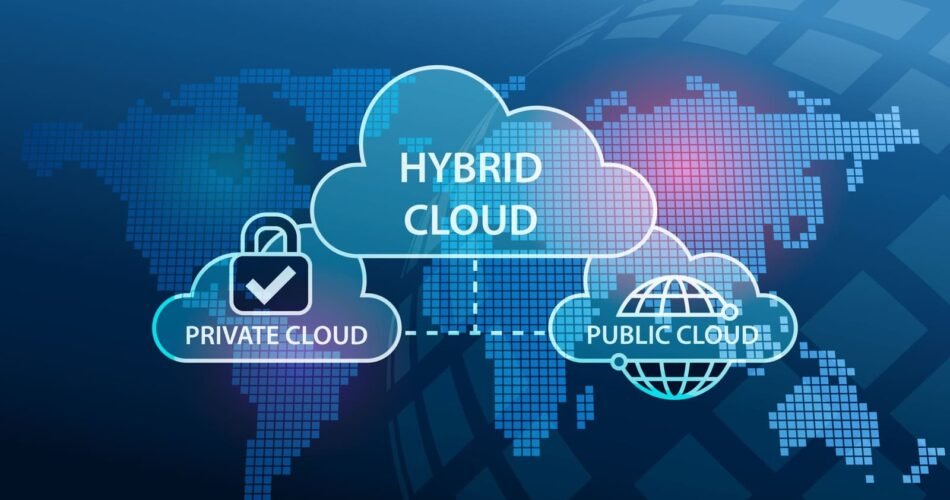
- Public Cloud: The infrastructure of huge data centers is owned and managed by an external entity that rents out virtual machines, storage, and databases through the internet. Several organizations make use of the same physical infrastructure but in such a way that each organization’s data remains separate from others using software. You pay for what you use.
- Private Cloud: The infrastructure of the cloud is dedicated solely to your company. It can be set up in your office or data center, or in single-tenant physical infrastructure provided to you by the cloud provider. You get modern cloud infrastructure without sharing hardware with other tenants.
- Hybrid Cloud: This is a combination of private cloud and public cloud infrastructure. Databases remain locked within the private cloud infrastructure, whereas websites and traffic bursts are operated in the public cloud.
| Feature | Public Cloud | Private Cloud | Hybrid Cloud |
| Hardware Sharing | Multi-tenant (shared physical hosts) | Single-tenant (exclusive hardware) | Mix of single-tenant and shared |
| Setup Speed | Minutes via self-service dashboard | Days to weeks (or hours if hosted) | Phased rollout across environments |
| Scalability | Near-instant elastic scaling | Limited by reserved hardware capacity | High elasticity for burst workloads |
| Data Control & Privacy | Standard provider security controls | Full physical and logical isolation | Custom placement by data sensitivity |
| Cost Pattern | Pay-as-you-go hourly or monthly | Predictable fixed infrastructure cost | Balanced fixed plus variable spend |
When does a public cloud make the most sense for a mid-size company?
The public cloud is the ideal option for your medium-sized company if you give priority to quickness, agility, and the absence of a cost of owning equipment above everything else.
If your e-commerce site engages in marketing campaigns, implements new technologies frequently, or works with changing levels of user traffic during weekdays and weekends, then the public cloud infrastructure is scalable for you without having to buy any unnecessary equipment. The engineers of your company can launch virtual machines, Kubernetes clusters, and even object storage in no time.
Working with a regional cloud computing service provider like CloudPe makes public cloud adoption even smoother for mid-size businesses in India. Instead of dealing with foreign currency fluctuations or steep outbound bandwidth charges from overseas hyperscalers, teams get local Tier-4 data center speed in Mumbai and Delhi NCR, transparent rupee billing, and zero data egress fees.
Is a hybrid cloud the best balance for most growing mid-size companies?
Yes, a hybrid cloud is often the best balance for growing mid-size companies because it lets teams keep sensitive customer databases on private infrastructure while running public websites and seasonal traffic bursts in the public cloud.
Rather than forcing every application into a single box, a hybrid setup lets you match each workload to the environment where it performs best and costs least. In practice, a mid-size hybrid architecture often looks like this:
- Core Systems on Private Infrastructure: Customer personal data, financial ledgers, and steady internal databases stay on isolated private servers with strict access controls.
- Customer-Facing Apps in the Public Cloud: Marketing sites, mobile app APIs, software testing sandboxes, and AI inference endpoints run on scalable public cloud instances that expand automatically during peak traffic.
- Private Network Linking: Secure virtual private cloud (VPC) connections and encrypted tunnels let both environments share data smoothly, while secondary cloud regions handle automated backups and disaster recovery.
How do you choose the right cloud model without overspending?
You can choose the right cloud model without overspending by auditing your workloads one by one, separating steady baseline usage from unpredictable traffic spikes, and checking for hidden bandwidth fees.
Before signing a multi-year contract or migrating your entire IT stack, run through three practical steps:
- Classify according to compliance risk: Classify which databases have financial, medical, or personally identifiable customer information that can be protected through single-tenant isolation.
- Classify steady vs. burst workloads: Measure server workload for three months. The workloads that run all day steadily should run on fixed-rate private or reserved instances, whereas burst workloads should run on elastic public cloud servers.
- Total monthly cost of ownership: Take into account more than just the compute rate and compare costs of outbound data transfer and storage of backup data along with the human response time of technical support 24/7.
Frequently Asked Questions
Is a private cloud necessarily more costly than a public cloud for a mid-size company?
No, a private cloud is not necessarily more costly than a public cloud for a mid-size company since consistent 24/7 applications are generally cheaper on fixed-rate single-tenant hardware than metered public hardware with constant bandwidth costs.
Do you need a big IT team to maintain a private or hybrid cloud?
No, you do not need a big IT team to maintain a private or hybrid cloud since the hosted cloud service provider will take care of the physical servers, power redundancy, hardware replacement, and network security for you.
Can a mid-size company start with a public cloud and then go hybrid?
Yes, a mid-size company can start with a public cloud and then become hybrid by maintaining the existing web applications on the public cloud while moving the sensitive databases to separate private servers that are connected through a private network.
What is the biggest mistake mid-size companies make when choosing a cloud strategy?
The biggest mistake mid-size companies make when choosing a cloud strategy is moving every application into one environment without comparing ongoing data egress fees, compliance requirements, and steady-state compute costs.
