
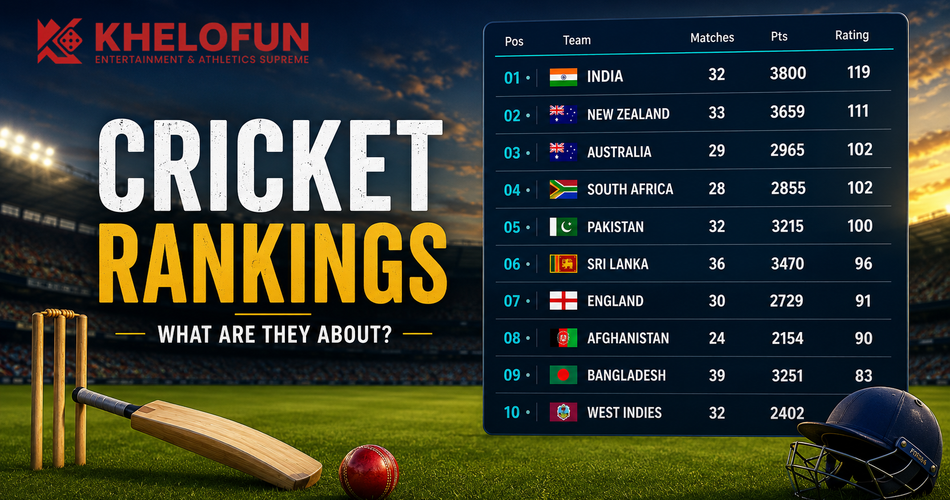
Fans of cricket regularly discuss the top-performing sides and individuals in this sport. However, many ask how such rankings are determined. In order to identify consistent performance, the ICC has a ranking system that allows determining where the team stands compared to other world teams and players.
As opposed to tournament ratings, which are calculated after each tournament, the ICC ranking system changes after every international series and match, when teams are awarded with points. Ranking is awarded to individual players according to their performance in batting, bowling, or being an all-rounder. Knowledge about such ranking system makes watching international cricket matches more interesting.
Be it Test cricket, ODI or T20I, the ICC rankings will allow you to compare teams and players playing in different formats in an objective way.
What Are ICC Cricket Rankings?
Khelofun explains the ICC rankings, the official ratings for international cricket. ICC ranking system ranks national teams and individual players in three formats of the sport. This ranking system values the consistency of the teams, not only occasional achievements, which means that the teams should perform well throughout the year.
Consequently, every result can affect a team’s or player’s position.
ICC Rankings Cover
| Category | Formats |
| Team Rankings | Test, ODI, T20I |
| Batting Rankings | Test, ODI, T20I |
| Bowling Rankings | Test, ODI, T20I |
| All-Rounder Rankings | Test, ODI, T20I |
How ICC Team Rankings Work
Each of the teams receives a rating from the ICC according to their recent performances. Points are awarded to winning teams while those that lose will incur points.
For instance, if a high-ranking team is defeated, then there is an automatic deduction of ratings. If a low-ranking team defeats a higher ranking team, more rating points are earned.
Factors That Affect Team Rankings
- Match results
- Series victories
- Opponent’s ranking
- Home and away performances
- Recent performance record
The ranking system rewards consistency over several years. Therefore, one successful series rarely changes the rankings dramatically.
How ICC Player Rankings Work
Player rankings evaluate individual performances in international cricket. There are separate rankings of batsmen, bowlers, and all-rounders. Thus, someone may occupy first position in ODIs but not in Test matches.
The ICC considers several performance factors before updating player ratings.
Batting Rankings
- Batters earn rating points based on:
- Runs scored
- Strike rate
- Match situation
- Opposition quality
- Venue conditions
A century against a top-ranked bowling attack usually earns more rating points than an easy hundred against weaker opposition.
Bowling Rankings
Bowlers receive ratings according to:
- Wickets taken
- Economy rate
- Batters dismissed
- Match impact
- Opposition strength
Taking wickets at crucial moments may significantly improve ranking of a bowler.
All-Rounders’ Ranking
All-rounders should contribute to both bowling and batting. This is why their ranking reflects their performance in these two aspects. Therefore, consistent contributions in both disciplines improve their overall rating.
ICC Ranking Formula Explained
The ICC does not rely on simple averages. Instead, it uses a detailed statistical model that considers multiple performance factors. Recent matches also carry greater importance than older results.
The exact calculation remains confidential. However, the following factors influence rating changes.
| Factor | Impact on Ranking |
| Winning matches | Positive increase |
| Losing matches | Rating decreases |
| Strong opposition | Higher rewards |
| Weak opposition | Smaller gains |
| Recent performances | Greater importance |
| Older results | Reduced influence |
This balanced system prevents temporary form from causing major ranking changes.
Why ICC Rankings Matter
ICC rankings influence international cricket in several ways. Sides should have high ranks in the course of the year. Likewise, cricketers should strive to become first-ranked batters and bowlers.
Higher rankings also increase confidence before major tournaments. They demonstrate consistency against strong international competition.
Benefits of ICC Rankings
- Compare teams objectively
- Measure player consistency
- Improve tournament seeding
- Build player reputation
- Track long-term performance
Fans also enjoy following ranking battles throughout the cricket calendar.
Difference Between Rankings and Tournament Points Tables
Many fans confuse ICC rankings with tournament standings. However, both systems serve different purposes.
| ICC Rankings | Tournament Points Table |
| Based on long-term performance | Based on one tournament |
| Updated after international matches | Updated during the competition |
| Measures consistency | Measures tournament progress |
| Covers multiple years | Covers one event only |
Thus, a side may occupy first positions in ICC rankings but fail in World Cup.
Why Rankings Change Frequently
International cricket takes place throughout the year. Every completed series affects the ratings. Consequently, rankings change regularly as teams compete across different formats.
Strong performances against quality opponents usually produce larger rating gains. On the other hand, unexpected defeats can reduce ratings quickly.
This dynamic system keeps international cricket competitive throughout the season.
Can Players Lose Their Rankings?
Yes, player rankings change constantly. Poor performances reduce rating points over time. Additionally, missing international matches can also affect rankings because other players continue earning points.
Maintaining a top ranking requires consistent performances across multiple series. Therefore, staying number one remains one of cricket’s biggest challenges.
Which Formats Have Separate Rankings?
Each format has independent rankings because the skills required differ considerably.
- Test Cricket
- One Day Internationals (ODIs)
- Twenty20 Internationals (T20Is)
It is possible that a player performs excellently in one format but poorly in other. Therefore, separate rankings are maintained by ICC for different formats.
Common Misconceptions About ICC Rankings
Several myths surround the ICC ranking system now; Khelofun burst all. Understanding the facts helps fans interpret rankings correctly.
| Myth | Reality |
| One century guarantees No.1 ranking | Consistency matters more |
| Rankings depend only on runs | Multiple factors influence ratings |
| Older matches count equally | Recent matches carry more weight |
| Winning every match guarantees No.1 | Opposition strength also matters |
These factors make the ranking system more balanced and accurate.
Conclusion
The ICC ranking system provides an equal opportunity to measure performances of cricket in all formats. The system encourages teams and individuals that perform well consistently against their stronger opponents. In contrast to focusing on just a single match, the system considers excellence over time.
Whatever format you follow in the cricket world; Test, ODI, or T20I, you can better enjoy your favorite game by being aware of the ICC rankings. Each international match impacts the standings and hence becomes important in terms of ICC rankings.
